Research
Physics checked against NASA measurements.
Reinforcement learning finds and exploits every error in a simulator, so fidelity is a requirement, not polish. We run the game's own equations against published experiments and report the result, including where the model misses.
Excavation forces
Within 0.76–1.19× of measured bucket forces.
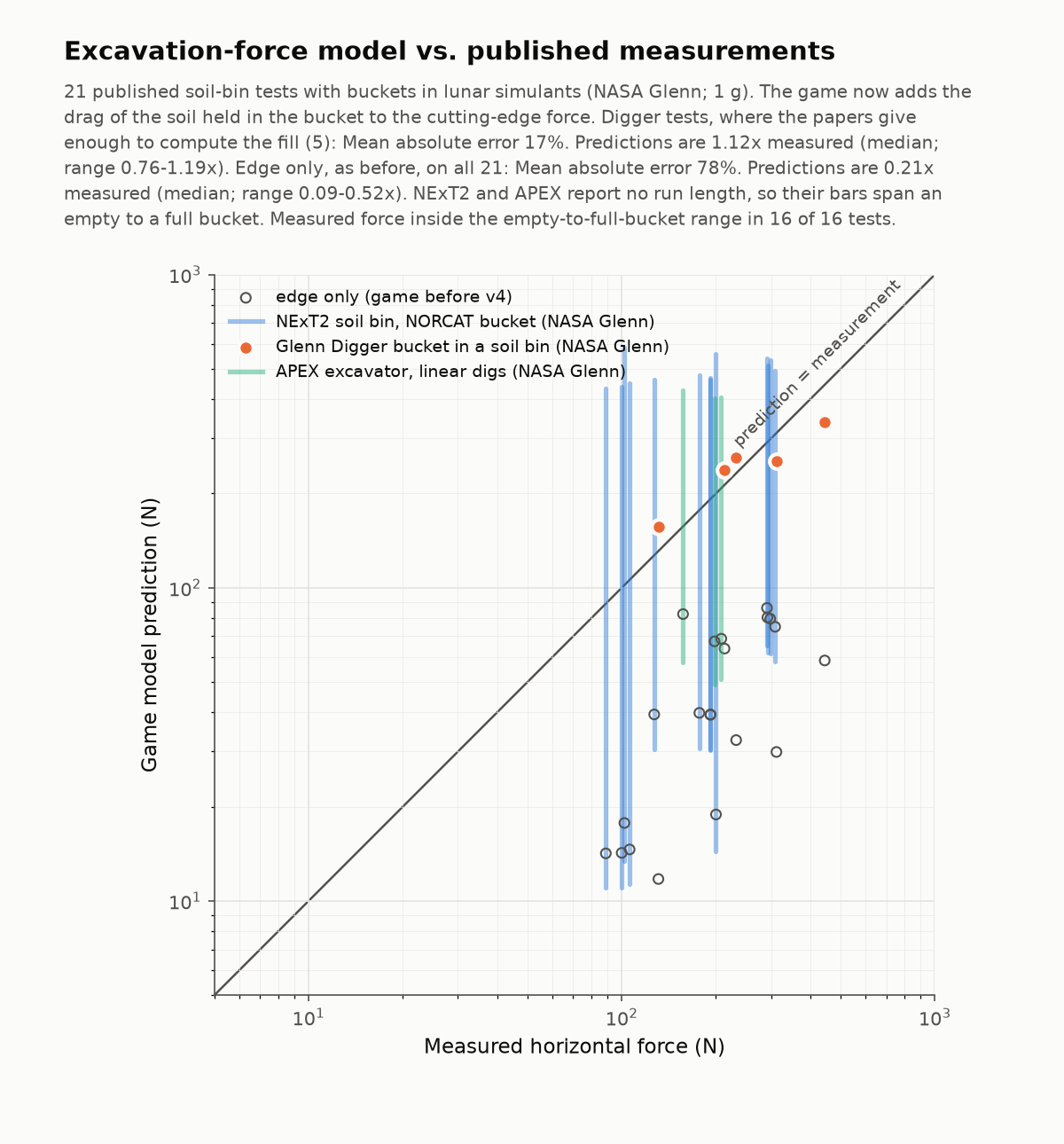
The game's cutting model (the McKyes/Reece earthmoving equation plus the drag of the soil held in the bucket, with no fitted constant) predicts a median 1.12× the measured horizontal force on the 5 NASA Glenn Digger bucket tests in lunar simulant, with a mean absolute error of 17%.
- Those 5 are the only tests whose papers report enough to work out how much soil was in the bucket.
- The other 16 tests (NExT2 and APEX) are a weak check: the papers don't give run length, so the prediction can only be bounded from an empty to a full bucket. Every measurement falls inside that range, but the range is wide.
- The cutting-edge term alone, as the game ran before, under-predicted all 21 tests (median 0.21×). That finding is why the bucket-fill term was added.
- All tests were at Earth gravity. Lunar gravity itself has not been validated.
Wheels on soil
0.93× measured drawbar pull at 30% slip and above.
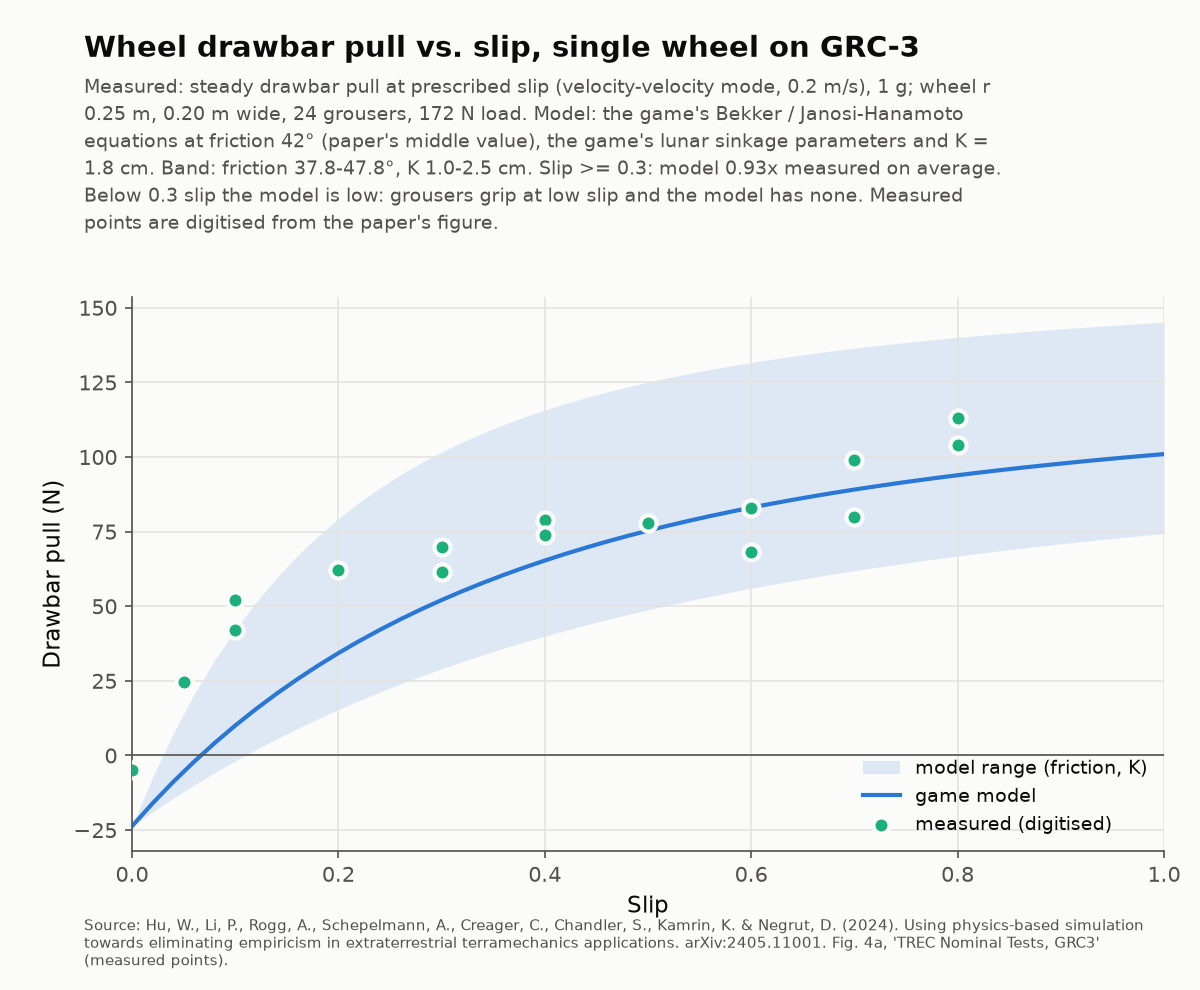
The wheel model (Bekker pressure–sinkage with Janosi–Hanamoto slip), run at a NASA Glenn single-wheel test's own wheel size, load and soil, gives 0.93× the measured pull on average at 30% slip and above.
- Below 30% slip it is about 30 N low, where the test wheel's grousers grip; the model has no grousers.
- Not validated: the game machine's own wheels, lunar or Mars gravity, or the Mars soil parameters.
Learning from game sessions
A policy trained on game data digs the trench to spec.
A small neural network trained by behavior cloning with DAgger, on logged game sessions only, digs an 8 m trench to spec on 47 of 50 held-out random starts on the Moon. A job meets spec when it finishes with mean depth within 5 cm of the 0.35 m target.
| Controller | Completes | Meets spec | Time | Mean depth | Cutting energy |
|---|---|---|---|---|---|
| Scripted baseline | 36/50 | 0/50 | 56.2 s | 0.70 m | 79 kJ |
| Previous policy (trained on the old expert) | 48/50 | 0/50 | 68.2 s | 0.72 m | 89 kJ |
| Human, 34 sessions, one player | 34/34 | 22/34 | 76.0 s | 0.37 m | 69 kJ |
| Scripted expert with depth control | 50/50 | 50/50 | 30.9 s | 0.34 m | 43 kJ |
| Learned policy (shipped) | 47/50 | 47/50 | 31.1 s | 0.35 m | 44 kJ |
Medians over completed runs. Test seeds 9000–9009, 5 episodes each.
- The shipped policy is trained on scripted-expert data only. No human data is in it. Human sessions were tested in a separate variant, with no evidence yet that they help.
- The expert is a script we wrote, and the policy matches it rather than beating it. The gain over the previous policy came from fixing the script, which had been digging twice too deep.
- The policy reads exact machine state, not camera images. The spec is ours, at one site, and hasn't been checked against a real machine.
More detail
Sources, methods and what's approximated.
The simulation fidelity page on offworldbuilder.com lists every model, its source and its status. The loop page covers the training pipeline. Every result is reproducible from a script, a seed list and a commit; we share the full write-ups and data with partners and reviewers on request.